
Most medspas market the same way. Post on Instagram a few times a week. Run some Facebook ads. Maybe pay someone to "do SEO." Hope the phone rings.
After analyzing 505 structured medspa audits, the pattern is clear: the problem is almost never a lack of marketing. It's marketing that leaks.
Somewhere between the ad click and the booked consultation, patients disappear. The traffic is there. The spend is there. But the calendar stays inconsistent — and nobody can explain why.
This guide covers the full medspa marketing system. Not a list of tactics you already know, but how the channels connect into a pipeline that turns visibility into booked consultations. You'll learn where most clinics leak, which channels matter at your growth stage, what to spend, and how to build a 90-day plan that fixes your biggest problem first.
What MedSpa Marketing Actually Is (And Why Most Clinics Get It Wrong)
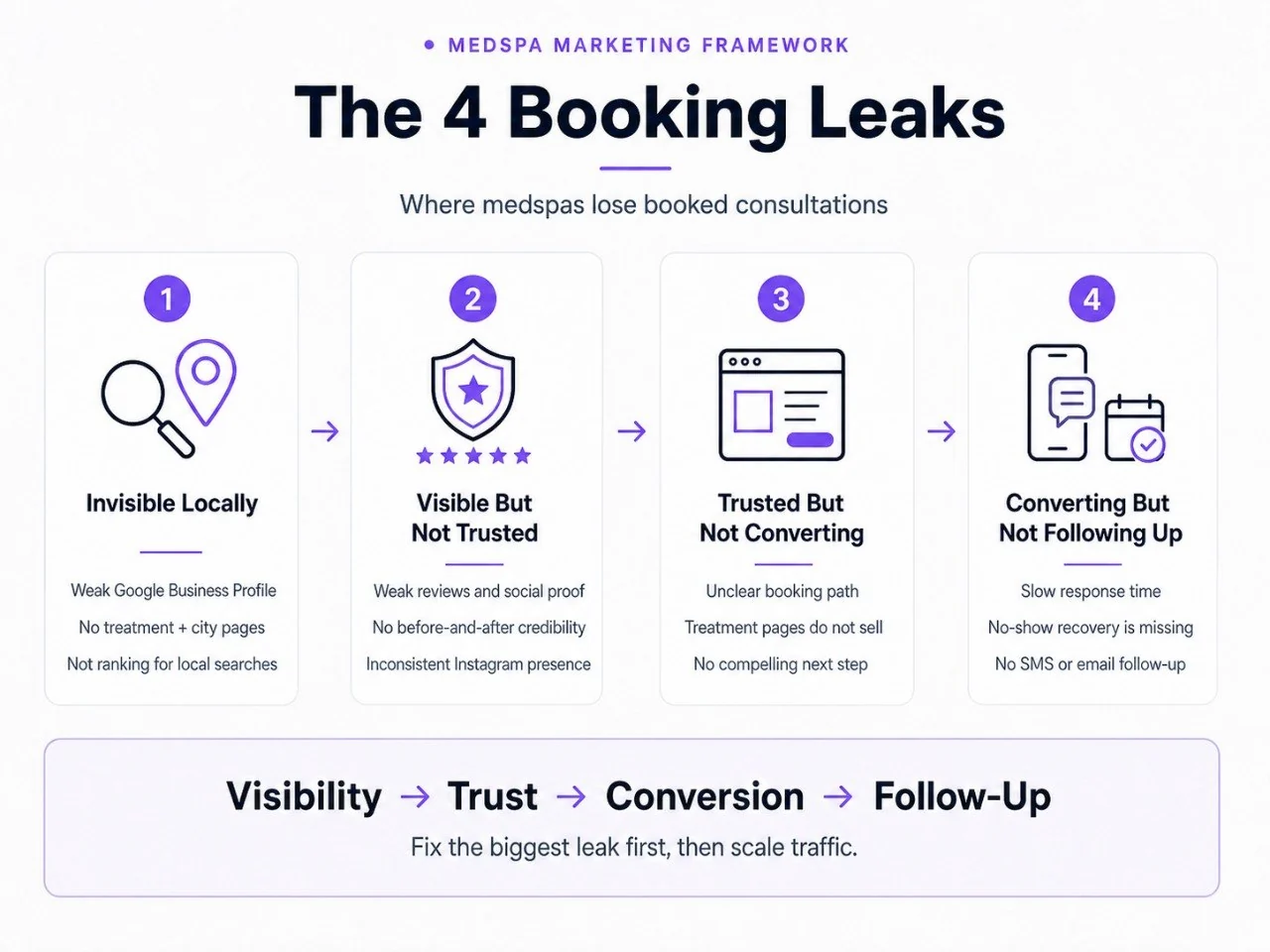
MedSpa marketing is a four-stage system — visibility, trust, conversion, and follow-up — not a list of channels. Most clinics fail because they invest in individual tactics without connecting them into a pipeline. The result: traffic that never converts, leads that never get called, and ad spend that produces clicks but not consultations.
The real issue is usually not the channel. It's the connection between channels.
A Google Ad that drives traffic to a homepage with no clear booking path is not a marketing problem. It's a conversion problem. A full Instagram feed that never gets referenced on the website is not a social media problem. It's a trust gap. Five hundred leads in a CRM that nobody called back within an hour is not a lead quality problem. It's a follow-up failure.
When we audit a clinic, we don't start with "what channels are you using." We start with "where are patients dropping out of your patient acquisition funnel." The answer determines everything.
The goal is not impressions, reach, or even leads. It's cost per booked consultation — a single number that tells you whether your marketing system is working or leaking.
Why Medical Spas Can't Market Like Regular Local Businesses
Medical spas face five constraints that generic local businesses don't: higher-consideration purchases with 2–8 week decision cycles, medical-grade trust requirements, HIPAA compliance on targeting and creative, treatment-specific seasonality, and multi-touch patient journeys where follow-up systems determine revenue more than ad spend does.
Higher consideration purchase. Nobody impulse-books a $3,000 CoolSculpting treatment. The typical decision cycle is two to eight weeks from first awareness to booked consultation. That means your marketing needs to nurture, not just attract.
Medical-grade trust threshold. Patients are choosing a medical provider, not a service. They need to trust the practitioner, the facility, and the outcomes before they'll commit. Reviews, credentials, and before-and-after proof carry more weight here than in any other local service category.
HIPAA constraints. Retargeting, email, and creative all operate under compliance boundaries that restaurants and salons don't face. You can't use patient data the way a regular business uses customer data, and your advertising creative has to navigate medical claims carefully.
Treatment-specific seasonality. Botox demand peaks differently than body contouring or weight loss. A static marketing plan that doesn't flex by treatment calendar wastes budget on low-demand windows and underinvests during high-demand ones.
Longer patient journey. The gap between first ad impression and booked consultation is often weeks. Follow-up and nurture sequences aren't optional — they're the difference between a lead and a patient. Clinics that treat marketing as a one-touch funnel lose to clinics that build multi-touch systems.
The 4 Booking Leaks: Where Most MedSpas Lose Patients
After hundreds of audits, the pattern is consistent. Most medspas leak bookings in one of four places. The first step in any medspa marketing strategy is figuring out which leak is yours.
Leak 1: Invisible Locally
The clinic doesn't show up when patients search for treatments in their city.
Google Business Profile is incomplete or unoptimized. There are no dedicated pages for individual treatments in the clinic's service area. The site doesn't rank for "[treatment] + [city]" queries — the highest-intent searches a medspa can capture.
This is the most common leak for new clinics, but it also affects established practices that never invested in local SEO. The fix starts with your Google Business Profile and a set of treatment-specific local pages. If you've never run through a structured local SEO checklist, that's the starting point. Your Google Business Profile alone can account for a significant share of local discovery — and most clinics leave it half-finished.
Leak 2: Visible But Not Trusted
The clinic shows up in search results or runs ads, but patients don't feel confident enough to book.
The Instagram looks inconsistent or amateur. Reviews are sparse or stale. The website has no before-and-after gallery, no provider bios with real credentials, and no social proof above the fold. The patient sees you, evaluates you, and chooses a competitor who looks more credible.
Trust is built across multiple surfaces. Your Instagram is not a growth channel — it's a trust channel. Patients check it before they book, and if it's full of stock-photo graphics and inconsistent posting, you lose them silently. Review velocity matters more than review count — a clinic with 40 reviews from the last three months outperforms a clinic with 200 reviews that stopped two years ago. Your review strategy should be systematized, not left to chance.
Leak 3: Trusted But Not Converting
Patients visit the website but don't book. The traffic is there. The trust signals are there. But the site doesn't close.
The most common version of this: a homepage that talks about the clinic but never asks for the booking. Treatment pages that describe the procedure but have no clear call to action, no pricing guidance, and no urgency. A treatment page structure that's built for SEO but not for the human who landed on it.
Every touchpoint needs a next step. If the content builds interest but offers no path to act, interest fades.
Leak 4: Converting But Not Following Up
Leads come in and die. The form submission sits in an inbox for three days. The phone call goes to voicemail during lunch. The no-show doesn't get a rebooking text. The patient who came once never hears from the clinic again.
This is the most expensive leak because you've already paid to acquire the lead. Every dollar spent on ads, SEO, and content is wasted if the follow-up system is broken.
Speed to lead is the single biggest conversion variable in medspa marketing. Clinics that respond within five minutes convert at dramatically higher rates than clinics that respond within an hour. Track consultation show rates and build a no-show recovery system. Train your front desk to convert, not just answer.
Core MedSpa Marketing Channels
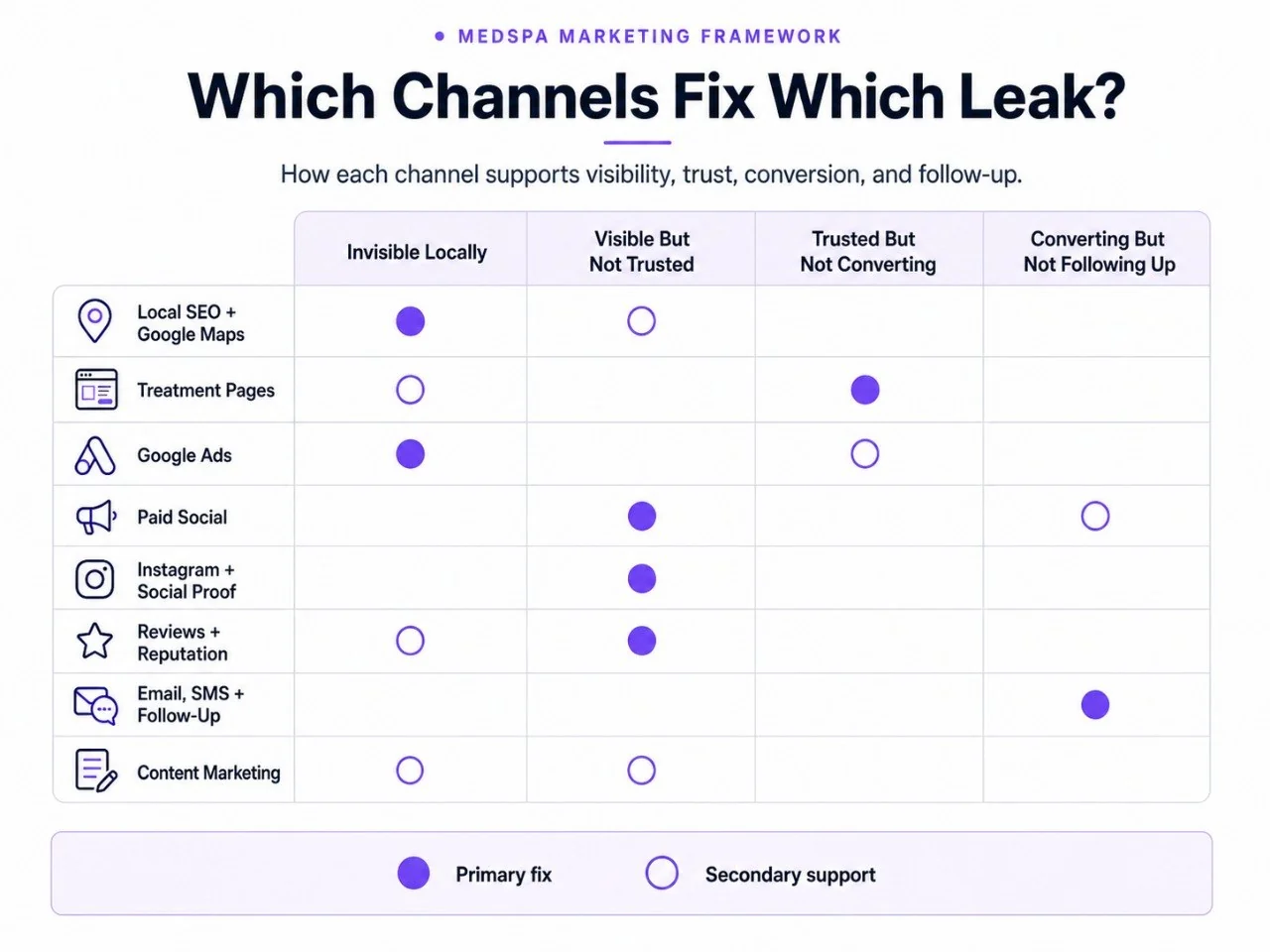
Every channel in medspa marketing serves one job: plugging one of the four leaks above. When you understand which leak you're fixing, the channel choice becomes obvious.
Local SEO and Google Maps
Local SEO captures patients who are already searching for treatments near them — the highest-intent traffic available to a medspa. When someone types "Botox near me" or "CoolSculpting [city]," you either show up or you don't.
The work includes Google Business Profile optimization, building treatment-specific pages for your service area, maintaining consistent name-address-phone data across directories, and generating a steady stream of reviews. If you're invisible locally, this is the first channel to fix. It addresses Leak 1 directly.
Treatment Pages and Local Landing Pages
Every treatment your clinic offers should have its own page, optimized for the treatment name plus your city. These pages bridge visibility and conversion; they rank for specific search queries and provide patients with enough information, trust signals, and urgency to book.
One page per treatment per location. Unique content on each. Structured for booking, not just for search engines. Each treatment has its own demand curve, competitive landscape, and patient psychology — from Botox to semaglutide weight loss to CoolSculpting.
Google Ads
Google Ads buys immediate visibility for high-intent treatment searches. When a patient searches "laser hair removal in [city]" and you're not ranking organically yet, paid search puts you in front of them today.
The catch: Google Ads only works if the landing page converts and the follow-up system exists. Running ads into a homepage with no clear booking path is the most common form of medspa ad waste. Our Google Ads guide covers setup, keyword strategy, and budget allocation in detail.
Paid Social — Meta and TikTok
Paid social generates demand for treatments patients aren't actively searching for. A well-targeted Meta ad can introduce CoolSculpting or Sculptra to someone who's never Googled it but fits the ideal patient profile.
This is a fundamentally different role than Google Ads. Google captures existing demand. Social creates new demand. That distinction matters because social leads require more follow-up. They haven't self-selected the way a search lead has. Without a working nurture sequence, social ad spend leaks into Leak 4. The paid social ads mastery guide covers Meta and TikTok setup, targeting, and scaling.
Instagram and Social Proof
Instagram is not a patient acquisition channel for most medspas. It's a trust channel.
Patients check your Instagram before they book. They're looking for recent activity, real results, provider personality, and visual consistency. If the feed looks abandoned or overly polished with stock graphics, they leave without telling you why. The key is showing real work, real patients (with consent), and real personality; not a curated gallery of branded tiles.
Reviews and Reputation
Patients check reviews before booking. A clinic with 40 recent reviews outperforms a clinic with 200 stale ones because review velocity signals active credibility.
The fix is systematic: post-appointment review requests via text or email, a direct link to your Google review page, and a staff process that makes it part of checkout. Reviews also feed local SEO rankings directly, making this one of the few channels that plugs two leaks simultaneously.
Email, SMS, and Lead Follow-Up
This is where Leak 4 gets fixed, and it's where most of the revenue recovery lives.
The math is straightforward: if your clinic generates 100 leads per month and your team follows up with 60 of them within the first hour, the other 40 are almost certainly lost. Speed to lead, automated booking confirmations, no-show rebooking sequences, and reactivation campaigns for lapsed patients are not optional. They're the highest-ROI marketing activity most clinics aren't doing. The email vs. social comparison helps clinics decide where to invest their retention budget.
Content Marketing and Patient Education
Blog content, educational videos, and treatment FAQs build authority over time. They support local SEO by giving Google more pages to rank, and they support trust by positioning your providers as experts.
The key: blog content should drive traffic toward treatment pages and booking paths, not exist in isolation. A blog post about "what to expect during your first HydraFacial" should link to the HydraFacial treatment page, which should have a booking CTA. Content without a conversion path is a visibility play with no commercial outcome.
MedSpa Marketing Strategy by Growth Stage
The right medspa marketing strategy depends on where your clinic is today. What works for a three-location practice with inconsistent bookings is different from what works for a new medspa that just opened its doors.
| Stage | Primary Leak | First Action | Channel Priority |
|---|---|---|---|
| New (0–6 months) | Leak 1: Invisible | GBP + treatment pages + reviews | Local SEO, then Google Ads |
| Growing (inconsistent bookings) | Leak 3 or 4 | Full funnel audit | Fix the constraint first |
| Established / multi-location | Efficiency | Automation + per-location tracking | All channels, optimized |
New medspa — first 6 months
Priority: get found locally and start generating reviews.
Set up and fully optimize your Google Business Profile. Publish 5–10 treatment pages targeting your core services plus your city name. Launch a review generation system so every patient leaves a review from day one. Add one paid channel: Google Ads if your budget supports it, Meta ads if not.
Don't try to run every channel simultaneously. Fix Leak 1 first, because nothing else works if patients can't find you. Local SEO is the foundation. Everything else builds on top of it.
Growing clinic with inconsistent bookings
Priority: find the biggest leak and fix it before adding more channels.
This is where most medspas waste money. The instinct is to spend more: more ads, more social, more content. But if the funnel is broken, more traffic just means more waste.
Audit your full patient acquisition system. Check whether the problem is visibility, trust, conversion, or follow-up. In our experience auditing hundreds of clinics at this stage, the issue is usually Leak 3 or Leak 4 — the site doesn't convert well, or leads aren't followed up fast enough. Fix the constraint, then scale the channel that's already producing results.
Established or multi-location medspa
Priority: systems, efficiency, and cost-per-booked-consultation tracking across locations.
At this stage, the question shifts from "how do I get patients" to "how do I get patients efficiently at scale." That means marketing automation, standardized follow-up workflows across locations, retention campaigns for existing patients, and real-time reporting that ties ad spend to booked consultations, not just leads.
The biggest trap for multi-location clinics is assuming what works at one location works everywhere. Each location has its own competitive landscape, review profile, and local search position. Market them individually.
How Much Should a Clinic Spend on Marketing?
Established medspas typically spend 7–12% of revenue on marketing; new or aggressively growing clinics spend 15–20%. But the total budget matters less than allocation. Most clinics over-invest in visibility channels and under-invest in conversion and follow-up — the stages where the majority of booking leaks occur. For current ranges by channel, use the dedicated medspa marketing cost guide.
A rough allocation framework:
- 30–40% on paid acquisition (Google Ads and Meta).
- 20–30% on SEO and content (local pages, treatment pages, blog).
- 15–20% on social media management (Instagram, content creation).
- 10–15% on email, SMS, and follow-up systems.
- 5–10% on reputation management and review tools.
These numbers shift depending on your growth stage and where your biggest leak is. A new clinic should weight toward local SEO and Google Ads. A clinic with strong visibility but poor conversion should shift budget toward website optimization and follow-up systems.
The number that actually matters is cost per booked consultation. Not cost per click, not cost per lead, not impressions. If you spend $5,000 this month and book 20 new consultations, your cost per booked consultation is $250. Compare that to your average patient lifetime value. If the lifetime value of a patient is $2,000+, the math works. If you don't know your cost per booked consultation, you don't know whether your marketing is working; you're guessing.
Don't compare your budget to a competitor's budget. Compare your cost per booked consultation to your average patient lifetime value. That ratio tells you everything.
90-Day MedSpa Marketing Plan
Every clinic's 90-day plan looks different. The sequence depends on where you're leaking. But the framework is the same.
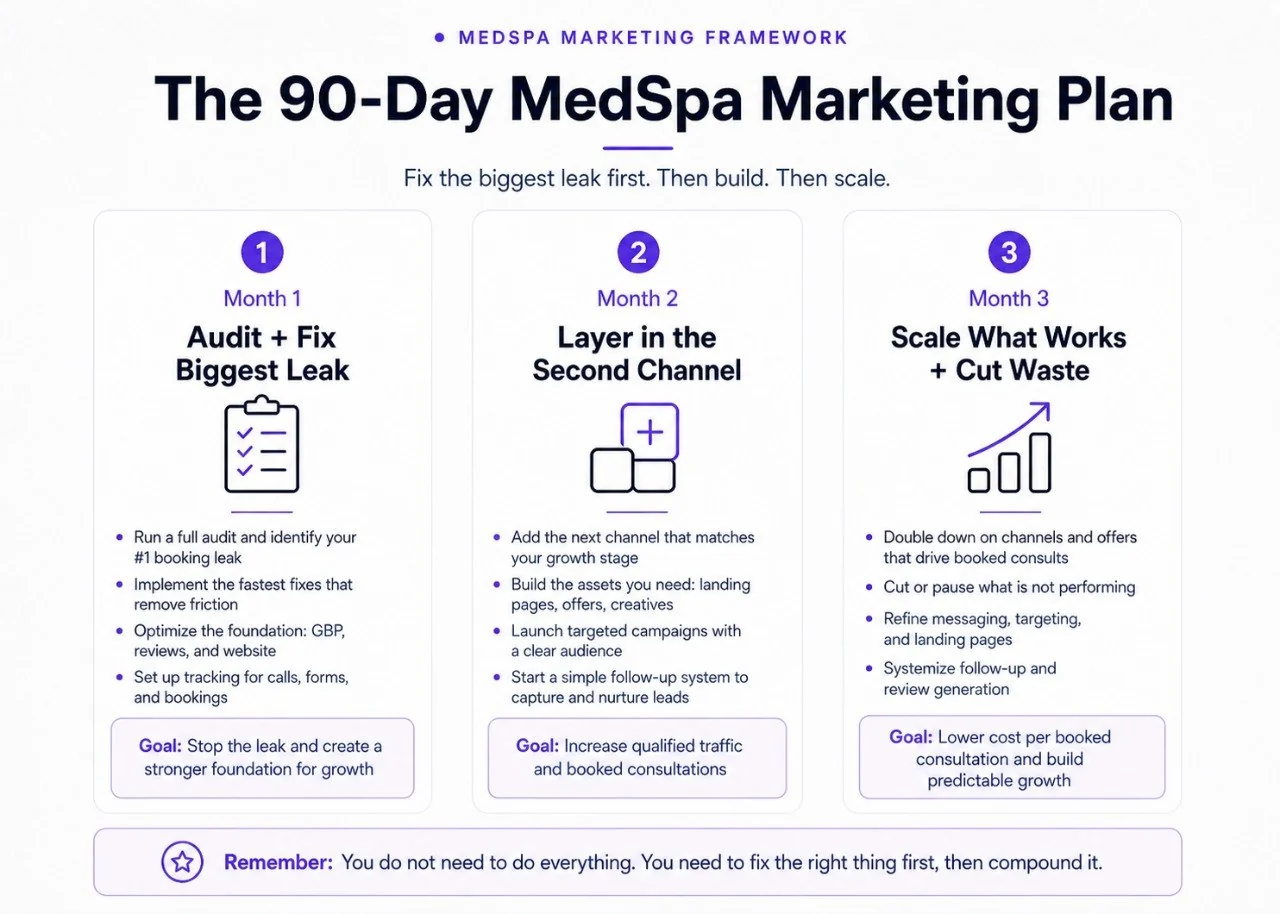
Month 1: Audit and fix the biggest leak
Score your clinic across the four leak areas: local visibility, trust and social proof, website conversion, and follow-up speed. Identify the single biggest constraint — the one place where fixing it would move the most bookings.
Fix that one thing. Don't touch anything else yet.
Set up tracking: call tracking, form submission tracking, booking attribution. You need to measure cost per booked consultation from day one, because that's the number you'll optimize against for the next two months.
Month 2: Layer the second channel and optimize
Your biggest leak is now plugged, or at least improving. Layer the next-highest-leverage channel.
If Month 1 was local SEO, Month 2 might be Google Ads to accelerate visibility while organic rankings build. If Month 1 was fixing follow-up speed, Month 2 might be Instagram to close the trust gap.
At the same time, optimize Month 1 results based on 30 days of data. What's the show rate on booked consultations? What's the follow-up response time? Which treatment pages are converting and which aren't?
Month 3: Scale what works, cut what doesn't
You now have 60 days of data. Double down on the channel producing the best cost-per-booked-consultation. Pause or reduce spend on anything that isn't converting into actual bookings.
Establish the monthly cost-per-booked-consultation benchmark you'll track going forward. This number becomes the baseline against which every future marketing decision is measured.
This framework isn't a full playbook, it's a starting structure. The audit determines the sequence. That's why every engagement we run starts with the audit, not a package.
The Mistakes That Waste the Most Budget
The most expensive medspa marketing mistakes aren't about choosing the wrong channel. They're about running the right channel without the supporting system.
Spending on Google Ads without a landing page that converts and a team that follows up within minutes. Treating Instagram as a growth engine when its real value is trust — not discovery. Ignoring review velocity and hoping word-of-mouth handles reputation on its own. Measuring leads instead of booked consultations, which means you can't tell whether marketing is actually producing revenue.
Each of these compounds over time. Clinics that run ads into broken funnels don't just waste this month's budget — they train themselves to believe "ads don't work" and miss the real fix entirely.
We've documented the 10 most common medspa marketing mistakes in a detailed breakdown. If you recognize yourself in any of the leaks above, start there.
Need the full conversion path? Our medspa lead generation services connect SEO, paid traffic, landing pages, follow-up, and booked-consult tracking instead of treating each channel as a separate lead source.
When to Hire a MedSpa Marketing Agency
Not every medspa needs an agency. Some clinics have the internal capacity to run marketing well — especially in the early stages, when the channels are limited and the focus is narrow.
But there are clear signals that it's time to bring in outside help.
You're spending on marketing but can't tell what's actually producing bookings. Your cost per booked consultation is rising, or unknown. You've tried running ads, SEO, or social in-house, but can't execute consistently because the team is also running the clinic. You're growing and need systems that scale, not more tasks on your personal plate.
When evaluating an agency, look for medspa-specific experience; not general digital marketing shops that "also do healthcare." If you're comparing partners, our best medspa marketing agencies guide breaks down the main options, strengths, limitations, and red flags. Look for an audit-first approach, because anyone who sells you a package before diagnosing your biggest problem is guessing. Look for reporting tied to bookings, not vanity metrics like impressions, reach, or traffic. And avoid long-term contracts — if the work is producing booked consultations, you'll stay. If it's not, a contract just delays the reckoning.
Red flags: guaranteed rankings or lead counts before seeing your market, cookie-cutter packages with no diagnostic step, and reporting dashboards full of traffic and impression numbers with no connection to actual revenue.
How Medspa Market Pro Helps
The fastest way to identify your biggest booking leak is to benchmark against clinics in your market, not against generic industry averages. We score your clinic across local SEO, Google presence, review velocity, treatment page conversion signals, and follow-up speed against our 800-medspa benchmark. The audit surfaces the 2–3 fixes that move bookings fastest for your specific situation, delivered within 48 hours.
Then we execute. SEO, ads, Instagram, email, follow-up — whatever the audit says to fix first, we build it. Everything runs async. No calls. No meetings. No long-term contracts. Your team stays focused on patients. We handle the marketing.
Four ways to work with us depending on what your audit reveals:
- — Compliant campaigns, treatment pages, and follow-up systems built around booked consultations and patient acquisition.
- Instagram Management — Done-for-you content, stories, and engagement that turns your feed into a trust engine.
- Local SEO — Google Business optimization, local keywords, treatment pages, and review management to own your city in search.
- Treatment Takeover — Go all-in on a single treatment with dedicated landing pages, ads, SEO, and content.
Frequently Asked Questions
There is no single best strategy. It depends on where your clinic is leaking bookings. For most medspas, local SEO combined with a working follow-up system produces the fastest improvement because it captures high-intent patients who are already searching for treatments and makes sure they actually get booked.
Paid channels can produce bookings within days if the landing page and follow-up system are ready. Local SEO compounds over 3–6 months as pages build authority and reviews accumulate. Instagram builds trust over weeks of consistent posting. The timeline depends on which channel you prioritize and how fast your team follows up on leads.
Yes, any tool that touches patient data must be HIPAA-compliant. This includes your CRM, email platform, SMS system, and any form that collects health-related information. Platforms like Mailchimp and standard Google Forms are not HIPAA-compliant out of the box. Look for BAA-ready alternatives (Business Associate Agreement) such as Jotform HIPAA, Pabau, or a medical-grade CRM. Non-compliance risks fines starting at $100 per violation, scaling up to $50,000 per incident.
A strong benchmark is $150–$350 per booked consultation, depending on treatment value and market competition. High-ticket treatments like CoolSculpting or semaglutide weight loss can justify a cost per consultation above $300 because patient lifetime value often exceeds $2,000. Lower-ticket services like Botox should aim closer to $75–$150. The key metric isn't the cost alone — it's the ratio of cost per consultation to average patient lifetime value. Anything below 1:4 is healthy.
Yes, but growth is slower. Clinics that invest in local SEO, review generation, and referral systems can build a full patient pipeline organically — it typically takes 6–12 months to reach consistent booking volume. The tradeoff is time: paid ads buy speed, organic builds equity. Many clinics start with Google Ads to generate immediate bookings while SEO compounds in the background, then reduce ad spend as organic traffic takes over.
Most markets require 30–50 Google reviews with a 4.7+ average rating before a new clinic competes credibly in local search results. But velocity matters more than volume — 20 reviews earned in two months signals more trust to both Google and patients than 100 reviews accumulated over five years. Aim for 8–12 new reviews per month during your first year. Automate the request via a post-appointment text with a direct Google review link.
Five numbers give you a clear weekly pulse: cost per booked consultation, lead-to-booking conversion rate, speed to lead (average time between form submission and first contact), consultation show rate, and new Google review count. These five metrics cover the full funnel from spend to seated patient. If you only track one, make it cost per booked consultation — it's the single number that tells you whether your marketing system is producing revenue or burning budget.