
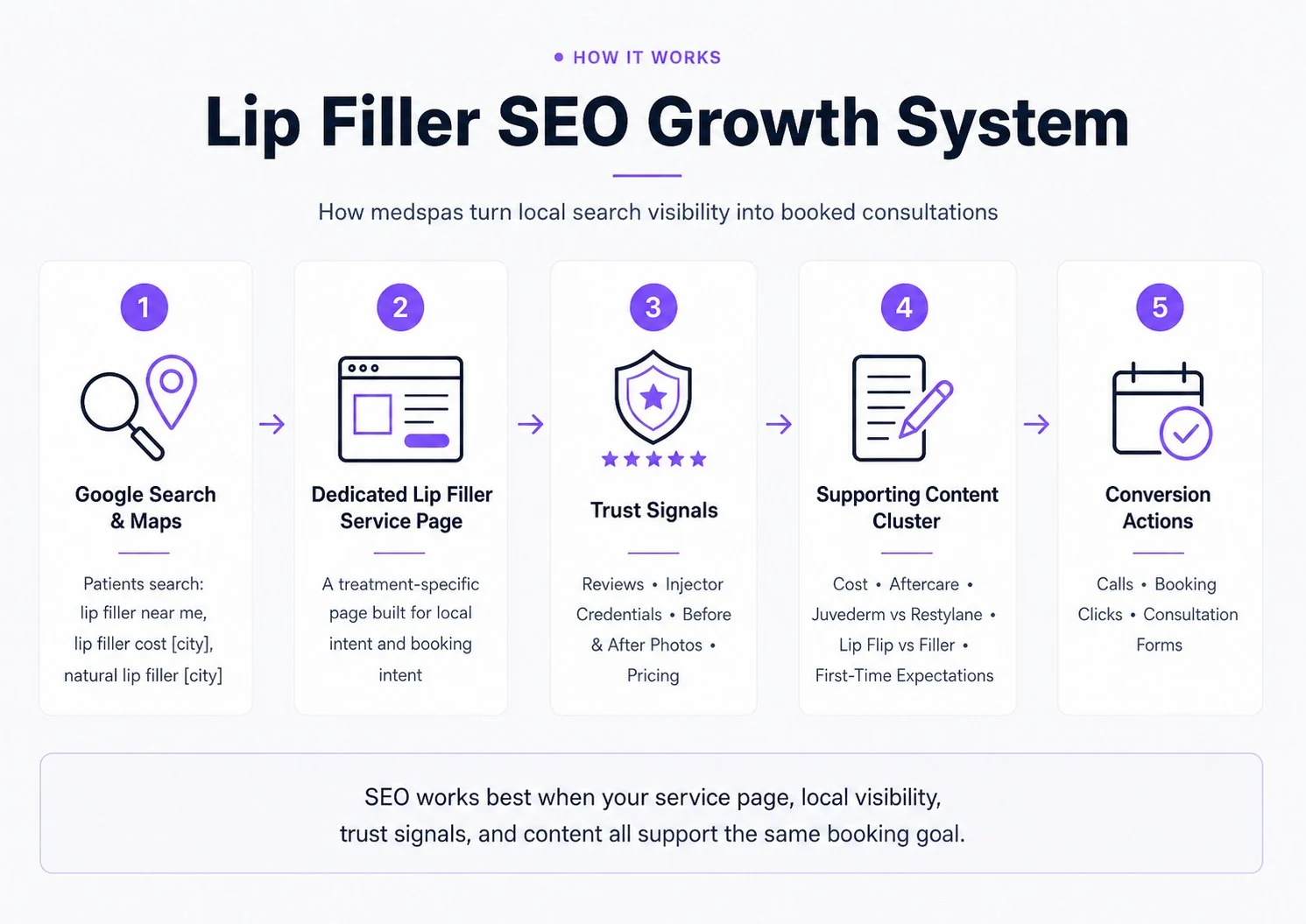
Most medspas list lip filler somewhere on their injectables page and assume that covers their lip filler SEO. It does not. A generic mention buried inside a broader service page rarely ranks for the searches that actually drive bookings — queries like "lip filler near me," "lip filler cost [city]," or "natural lip filler [city]."
Lip filler patients also tend to compare more aggressively than patients researching other treatments. The visual nature of the result, the fear of looking overfilled, and the relatively low price point all push patients to evaluate multiple providers before committing. If your page does not address injector credibility, expected results, and cost, they move on quickly.
This guide breaks down how to build a strategy that connects local search visibility with booked consultations — from the service page to the content cluster, through reviews, trust signals, and conversion infrastructure.
What Is Lip Filler SEO?
Lip filler SEO covers the technical, editorial, and local optimizations that help a medspa rank when patients search for lip injection services in a specific geographic area. Unlike generic medspa SEO, this approach targets treatment-specific queries tied to booking intent.
An effective strategy covers searches like:
- lip filler near me
- lip injections near me
- lip filler cost [city]
- best lip filler [city]
- natural lip filler [city]
- Juvederm lips near me
- Restylane lips near me
- lip filler consultation near me
These queries are valuable because they come from patients in active comparison mode — reading reviews, weighing prices, evaluating portfolios, and moving toward a booking decision.
Search volume for “lip filler near me” is significant nationally, but the real opportunity depends on your city, competition, and local search behavior. Medspas should verify exact volume with tools like Ahrefs, Semrush, or Google Keyword Planner before building the page.
Why This Strategy Matters More Than General MedSpa SEO
Patients considering lip filler are among the most research-intensive in aesthetics. They cross-reference Google, Instagram, TikTok, review sites, and clinic websites before making a decision. A competitor who communicates injector credibility, pricing transparency, and result quality more effectively can win the booking — even if your practitioners are objectively more skilled.
That is why lip filler SEO cannot stop at rankings. Every element on the page needs to serve two objectives: visibility in search results and conversion once the patient arrives.
If you are not sure whether your current marketing has these gaps, the 10 most common medspa marketing mistakes covers the patterns we see most often.
Start With a Dedicated Lip Filler Service Page
A generic "injectables" page usually cannot rank for lip filler queries. Google needs a page that clearly focuses on lip filler as a standalone treatment to index it as a relevant answer.
What to Include on the Page
- A headline containing "lip filler" and your city or service area
- An explanation of who the treatment is for: thin lips, asymmetry, volume loss, lack of vermillion border definition, or Cupid's bow reshaping
- Product options (hyaluronic acid fillers such as Juvederm and Restylane) with average longevity ranges (6 to 12 months depending on product and metabolism)
- Injector credentials (certifications, years of experience, aesthetic philosophy)
- Clear positioning around natural-looking results
- Pricing guidance or a starting price
- FAQs based on real patient searches
- Selected reviews or testimonials
- A visible consultation CTA
Headline Optimization
Instead of a vague headline like "Injectables in Austin," use something specific: "Lip Filler in Austin for Natural-Looking Volume and Definition." That level of specificity helps both search engines and patients understand the page immediately.
How to Capture "Near Me" Local Search Intent
When a patient types "lip filler near me," that is not an informational query — it is a local intent signal. They are looking for a nearby provider, not a general educational article.
Local Signals That Drive Map Rankings
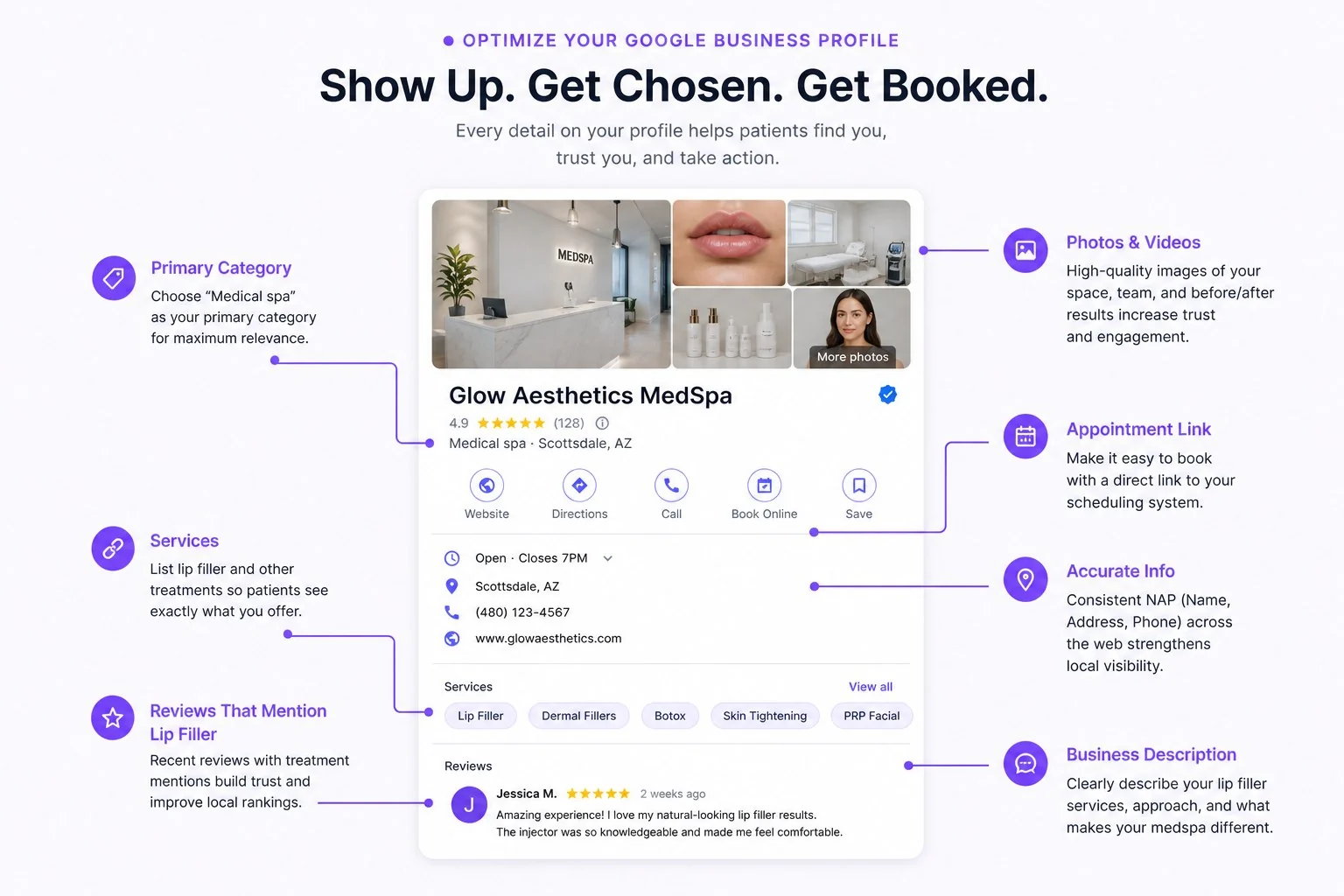
Ranking for this type of search requires a consistent set of local signals: an optimized Google Business Profile, NAP (name, address, phone) consistency across directories, service pages tied to your city, reviews mentioning the treatment, local backlinks, fresh photos, and clear contact information.
Local search can drive fast action: Think with Google data cited by BrightLocal says 76% of nearby mobile searches result in a business visit within 24 hours.
If you need treatment-specific pages optimized for "[service] + [city]" searches, local SEO landing pages are built specifically for that purpose.
Adding Location Context Without Stuffing
Your website should include geographic cues naturally. For example: "Our medspa provides lip filler consultations in Scottsdale for patients who want natural-looking volume, improved definition, and balanced facial proportions."
Do not repeat "lip filler Scottsdale" in every paragraph. Use city references where they are helpful: headline, title tag, intro, location section, testimonials, FAQ, and schema.
Optimize Your Google Business Profile for Treatment Visibility
For local SEO, your Google Business Profile can be just as important as your website. Many patients discover a clinic directly in Google Maps before ever visiting the site.
What Your Profile Should Include
Accurate business categories, lip filler listed as a service, treatment-related photos, updated hours, appointment links, strong review responses, regular Google Posts, and complete business information. Clinics with 50 or more Google reviews tend to dominate the local pack in most markets (the threshold varies by local competition).
Review Quality Matters
A review that says "Great service" is helpful, but a review that says "I got natural-looking lip filler with Sarah and loved the result" is far more powerful — both for patients and for local relevance. Encourage happy patients to mention the treatment they received, their experience, and the result they were hoping for. Never script reviews, but you can guide patients with an ethical prompt like: "What treatment did you receive, and what did you like about your experience?"
Turn Patient Reviews Into Ranking and Conversion Signals
Patients considering a dermal filler for their lips are often hesitant. They worry about looking overfilled, bruising, pain, cost, or choosing the wrong injector. Reviews reduce that hesitation.
For SEO and conversion, your reviews should ideally mention: the specific treatment, natural-looking results, the injector's name, comfort during the procedure (topical anesthetic, cannula vs. needle technique), consultation quality, and how the result looked after healing.
Add selected reviews directly to your lip filler page, prioritizing those that address the most common patient concerns. A testimonial like "I was nervous about getting lip filler for the first time, but the team explained everything and kept the result very natural" can be more persuasive than a generic five-star rating.
Build a Supporting Content Cluster Around Patient Questions
Your service page targets booking intent. Your blog content should support it by answering the questions patients ask before they book.
High-Value Blog Topics by Search Intent
| Topic | Search Intent | Funnel Stage | Links To | Best For |
|---|---|---|---|---|
| How much do lip fillers cost? | Commercial investigation | Mid-funnel | Service page pricing section | Price-conscious patients comparing providers |
| Juvederm vs Restylane for lips | Comparison | Mid-funnel | Service page product section | Patients researching filler brands |
| Lip filler aftercare | Informational | Post-booking / Top-funnel | Service page aftercare FAQ | Building trust with first-time patients |
| Lip flip vs lip filler | Informational / Navigational | Top-funnel | Service page + lip flip page | Patients unsure which treatment they need |
| First-time lip filler: what to expect | Informational | Top-funnel | Service page consultation CTA | Anxious first-time patients |
| Lip filler swelling stages | Informational | Post-treatment | Aftercare page | Reducing post-treatment support calls |
| Can lip filler be dissolved? | Informational | Pre-research | Service page safety section | Hesitant patients concerned about reversibility |
| Russian lip filler technique | Informational / Comparison | Mid-funnel | Service page technique section | Patients who saw specific results on social media |
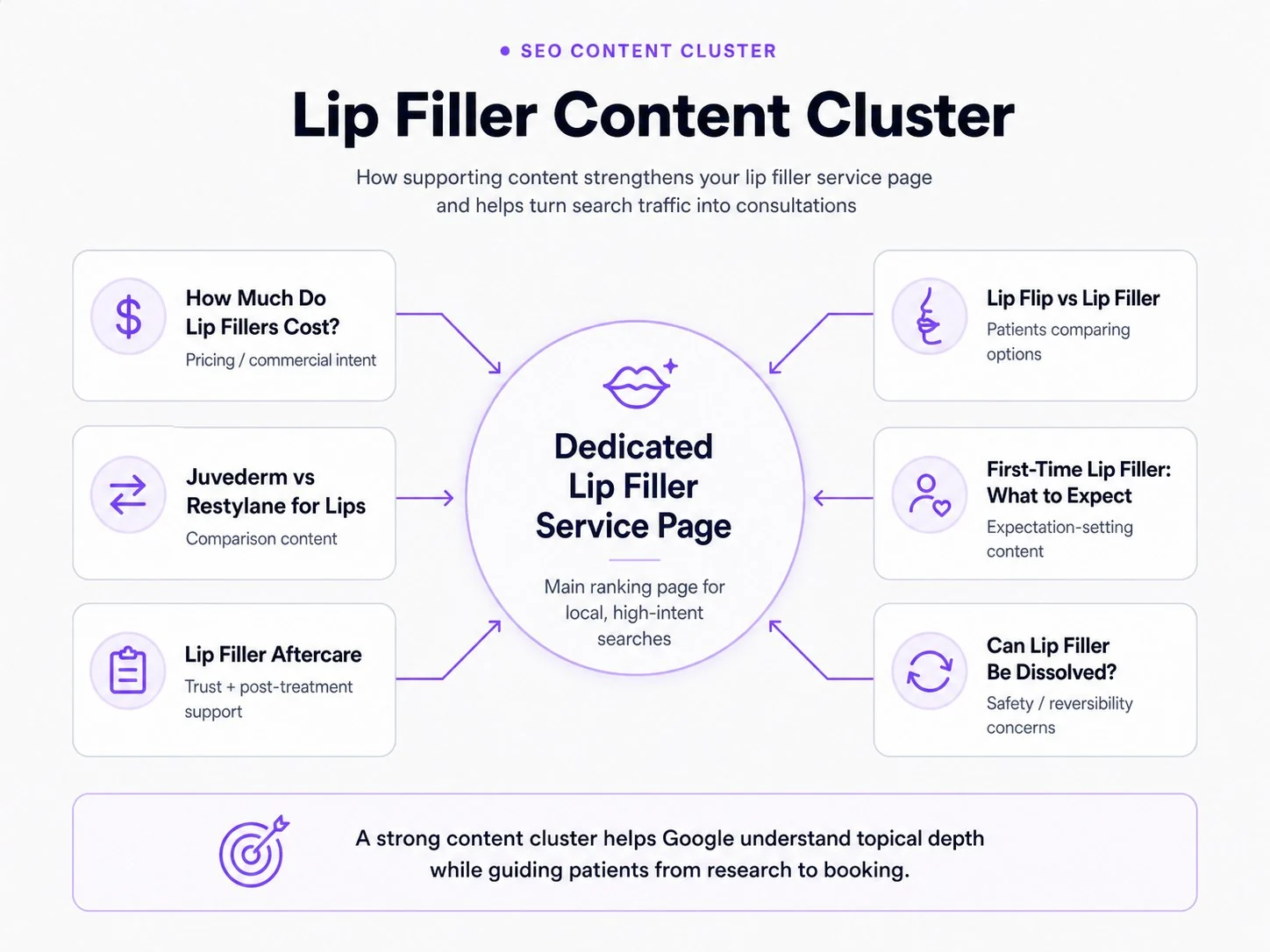
A minimum cluster of 5 to 8 support articles, each internally linked to the main service page, helps Google recognize topical depth on the subject. For a deeper look at how to plan, write, and structure blog content that actually drives bookings, see our guide on how to attract more clients with medspa blog content.
Internal Linking Structure for the Cluster
Every support article should include a link back to the main service page. The service page, in turn, can link to the most relevant articles to help patients dive deeper on specific points — aftercare, product comparisons, expectation management.
Address Lip Filler Cost Clearly
One of the biggest missed opportunities in lip filler SEO is pricing transparency. Patients are actively searching for this information — if your page does not address it, they leave and compare elsewhere.
You do not need to publish a fixed price, but you should give patients enough information to feel oriented. Cover: starting price, price per syringe (hyaluronic acid fillers typically range from $500 to $800 per syringe in the US — verify for your market), what affects cost, why injector experience justifies a higher price, why the cheapest filler is not always the best choice, whether a consultation is required, and whether touch-ups may be needed.
For example: "Lip filler pricing depends on the amount of product used, the type of filler selected, your anatomy, and your treatment goals. During your consultation, your injector will recommend a plan based on the result you want — whether that is subtle hydration, more definition, or fuller volume."
This approach builds trust without reducing your treatment to a discount offer.
Position Your Practice Around Natural Results
Many patients are not searching for dramatic results. They want subtle, balanced, natural-looking lips. Your SEO content should reflect that demand.
Use vocabulary that matches what patients actually search for: natural lip filler, subtle lip enhancement, balanced lip filler, lip definition, conservative lip filler, hydrated lips. Your copy should reassure patients that your approach is customized and anatomy-driven.
For example: "Our goal is not to create the same lips for every patient. We focus on proportion, facial balance, and natural-looking enhancement based on your existing features — respecting the shape of the vermillion border and Cupid's bow."
This type of language attracts better-qualified patients and differentiates your medspa from competitors using generic filler messaging.
Provider Credibility: Injector Profiles and Before-and-After Content
Lip filler is a trust-sensitive treatment. Patients want to know who is holding the syringe — or the cannula.
Injector Credentials and Experience
Your page should include: injector names, credentials (board-certified, nurse practitioner, specialized training), years of experience, aesthetic philosophy, patient safety approach, and consultation process.
Instead of "Our team is highly trained," say: "Your aesthetic consultation is performed by an experienced injector who evaluates your anatomy, lip shape, symmetry, and treatment history before recommending a filler plan." Specificity builds trust and increases the likelihood of conversion.
Before-and-After Photo Standards
Before-and-after photos can be highly effective for lip filler marketing, but they need to be used carefully. Your images should show realistic results, include proper patient consent, avoid misleading lighting or angles, and represent your actual work.
Alt Text Best Practices
Image alt text helps search engines understand the page, but it should stay natural. Good example: "Natural lip filler result after treatment at [MedSpa Name] in [City]." Bad example: "best lip filler near me cheap lip injections city lip filler cost." Your visuals should support trust, not look like keyword manipulation.
Improve Internal Linking
Internal links help Google understand which pages matter most on your site. If you create blog articles about lip filler, they should all link back to your main service page. Your broader marketing or service pages should also link to related lip filler content.
For example, from a commercial page about lip filler growth, you can link using anchor text like "lip filler marketing strategy for medspas." And from that commercial page back to this article using "lip filler SEO guide." This creates a stronger topical cluster around lip filler marketing and local SEO.
Minimum recommendation: 3 contextual internal links per article, pointing to articles within the same thematic cluster, relevant product category pages, and pillar articles.
Make the Page Conversion-Focused
SEO gets visitors to the page. Conversion turns them into consultations. Your lip filler page should make the next step obvious.
Strong CTAs include: "Book a lip filler consultation," "Schedule your first lip filler appointment," "See if lip filler is right for you," "Request a consultation," "View pricing and availability." Do not make patients hunt for the booking button.
Place CTAs: near the top of the page, after the treatment explanation, after pricing information, after FAQs, and at the bottom. As an internal benchmark, many clinics should aim to improve the percentage of visitors who call, submit a form, click to book, or request a consultation.
Make sure your mobile experience is strong as well. A significant share of lip filler searches come from smartphones, especially from younger patients comparing providers quickly.
Track the Right SEO Metrics
Many medspas track rankings and traffic but forget to measure bookings. For lip filler SEO, the most relevant metrics are: rankings for "lip filler near me" and "lip filler cost [city]," Google Business Profile calls, direction requests, website clicks from Maps, consultation form submissions, booking button clicks, phone calls from the lip filler page, cost per booked consultation, and reviews mentioning lip filler.
Traffic is useful, but booked consultations are the real goal. If your page ranks but does not convert, the problem likely comes from weak pricing information, poor trust signals, unclear CTAs, or a lack of reviews.
Request a free audit to see how your lip filler page metrics compare to top-performing medspas in your market.
Pre-Launch Audit Checklist
- Dedicated lip filler service page
- City or service area mentioned naturally
- Google Business Profile optimized for aesthetic services
- Reviews specifically mentioning lip filler
- Pricing questions addressed
- Injector credentials explained
- Natural-looking results shown (before-and-after photos)
- FAQs based on real patient searches
- Supporting blog content linked to the main page
- Booking CTA clear on mobile
- Calls, forms, and booked consultations tracked
If several of these are missing, your medspa is likely losing lip filler patients to competitors with stronger local visibility and better conversion systems.
Connecting Visibility to Booked Consultations
Most medspas treat lip filler SEO as a traffic problem. The real gap is usually between the traffic they already receive and the consultations that never materialize. A page that ranks but lacks pricing clarity, provider credibility, or a fast mobile booking path loses patients to competitors who address those three elements — even if those competitors rank lower.
Before investing in more content or backlinks, audit what happens after a visitor lands on your lip filler page. If fewer than 3% to 5% of visitors take a conversion action, the page structure needs attention before the SEO strategy does.
Medspa Market Pro helps aesthetic clinics build treatment-specific growth systems that connect SEO, paid search, retargeting, review generation, and booking infrastructure.
Choose the right next page: this article is the organic-search guide. Use the lip filler marketing service when you want implementation, or the lip filler marketing ideas guide when you want campaign concepts across SEO, social, email, and ads.
FAQ
Each location should usually have its own lip filler page so Google can clearly understand which page serves which city. A single page targeting multiple cities dilutes geographic signals and reduces your chances of appearing in the local pack for each area. Duplicating content without market-specific customization creates thin content risk.
In most markets, no. A single comparison integrated into the main service page — or a dedicated blog article like "Juvederm vs Restylane for Lips" — is usually sufficient unless local search volume for a specific brand justifies a standalone page. Check your market volumes before creating additional content.
SEO builds durable organic visibility but typically takes several months to produce results. Paid ads generate immediate traffic but stop the moment the budget is cut. The highest-performing medspas combine both: SEO for baseline visibility and paid search for demand spikes, service launches, or highly competitive markets. Cost per acquired consultation tends to decrease over time on the SEO side, while it remains stable or increases on the paid side.
Generic ads using treatment language like "lip filler" or "lip injections" generally work without LegitScript certification. However, ads that mention injectable filler brand names — Juvederm, Restylane — fall under Google's prescription drug advertising restrictions and typically require LegitScript verification. Policies evolve regularly, so verify current restrictions before launching any brand-name campaign.