
Your Instagram is active, your ads run every month, and referrals trickle in. But new patient flow isn't consistent, and you're not sure which marketing efforts are actually filling your schedule.
That's because most med spas have tactics, not a system.
Medspa patient acquisition is the process of consistently attracting new patients through channels like local SEO, social media, paid ads, and referrals. But the clinics that grow predictably don't just use these channels. They connect them into a structured system that generates consultations week after week.
In this guide, you'll learn how the medspa patient acquisition system works, the five pillars that drive predictable bookings, and how clinics combine SEO, ads, and med spa marketing strategies to stop guessing and start filling their calendars consistently. For the broader channel-by-channel strategy, see our medspa marketing strategy guide based on 505 structured clinic audits.
Key Takeaways: Medspa Patient Acquisition System
A successful medspa patient acquisition system typically includes:
- strong local SEO visibility for treatments
- paid campaigns to generate demand
- social proof and patient testimonials
- optimized consultation booking processes
- retention and referral systems
CHOOSE THE FIRST FIX
Find the stage that needs work before adding another channel
Patient acquisition connects discovery, inquiry handling, consultation and the clinic’s own treatment decision process. A low booking count does not identify which stage failed. Start with a defined period and follow the records as far as your systems allow.
| What you observe | Check next | Relevant work |
|---|---|---|
| Relevant searches rarely reach the website | Indexing, query intent and the treatment pages receiving exposure | Website SEO |
| Ad clicks arrive but few people inquire | Offer, landing-page detail, form usability and message consistency | Paid-social campaign and landing-page review |
| Inquiries arrive but remain unbooked | Delivery, response ownership, appointment availability and follow-up | Inquiry-to-booking workflow |
| Appointments are confirmed but not attended | Confirmation wording, reminders, directions and rescheduling | Attendance workflow |
A worked example with separate outcomes
Imagine a clinic records 20 inquiries in a month. Eight become confirmed consultations and six are attended. That is a 40% inquiry-to-booking rate and a 75% attendance rate among booked consultations. It is not 20 new patients. These are illustrative numbers, not an MMP client result or an industry benchmark.
The next check is why the other inquiries did not become bookings: unsuitable requests, failed delivery, unanswered messages or unavailable appointments need different fixes. Review the reasons before assuming the clinic needs more ad spend.
What to keep in the marketing report
- Source when known, with unattributed inquiries kept visible.
- Distinct counts for inquiries, qualified inquiries, booked consultations and attended consultations.
- The first response and the reason an inquiry did not progress, where known.
- The agreed next change and the date it was introduced.
Keep clinical notes in the clinic’s appropriate clinical system. Marketing reports should use the minimum information needed to understand the journey.
Opening a new clinic? Work through the pre-opening marketing checklist. For an existing clinic, request a free website audit so we can identify a practical starting point.
Why Most Med Spas Struggle to Get Consistent Patients
In today's competitive market, many medspas struggle to maintain a consistent flow of new patients because their marketing is fragmented rather than built around a structured acquisition strategy.
Many clinics rely on a mix of tactics that are not connected to a clear patient acquisition strategy. For example, they may post on Instagram regularly but neglect local SEO, run ads without a proper follow-up system, or depend heavily on referrals.
Some of the most common issues include:
- relying only on social media
- poor Google visibility for treatments
- weak lead follow-up
- no structured patient acquisition funnel
When these elements are disconnected, new patient flow becomes unpredictable. That's why successful clinics build a medspa patient acquisition system designed to generate consultations consistently.
If you're not sure whether your clinic is making these mistakes, read our guide on MedSpa Marketing Mistakes That Are Costing You Money.
The Medspa Patient Acquisition Funnel
To understand how clinics consistently book new patients, it helps to look at the medspa patient acquisition funnel.
Every patient goes through a series of steps before scheduling an appointment. First, they discover a clinic, then they evaluate whether they trust it, and finally they decide whether to book a consultation. If any step in this process is weak, potential patients drop off before becoming clients.
A strong patient acquisition system ensures that each stage of this journey is supported by the right marketing channels and processes.
The typical medspa patient acquisition funnel has four main stages.
1. Awareness
At the awareness stage, potential patients first discover your clinic. This often happens when they search for treatments on Google, see a social media post, or come across educational content online.
2. Consideration
Once patients discover a clinic, they begin evaluating whether they trust it. In the aesthetics industry, trust plays a huge role in the decision process. Patients often evaluate clinics based on results, reviews, and the professionalism of the clinic's team.
3. Conversion
The conversion stage is where leads turn into consultations and ultimately into patient bookings. This step often fails when clinics focus only on generating leads but neglect the processes that turn inquiries into appointments.
Measure consultation-to-treatment progression using the clinic’s own records and a defined period. Suitability, patient preferences and the clinical decision process affect whether treatment proceeds. Do not use an unverified industry percentage as a target for individual care.
Leads turn into booked appointments through fast responses, trained staff, clear online booking, and effective follow-up.
4. Retention and Referrals
The funnel does not end after the first visit. Successful med spas focus heavily on retention, referrals, and patient satisfaction. Satisfied patients often return for maintenance treatments and recommend the clinic to friends.
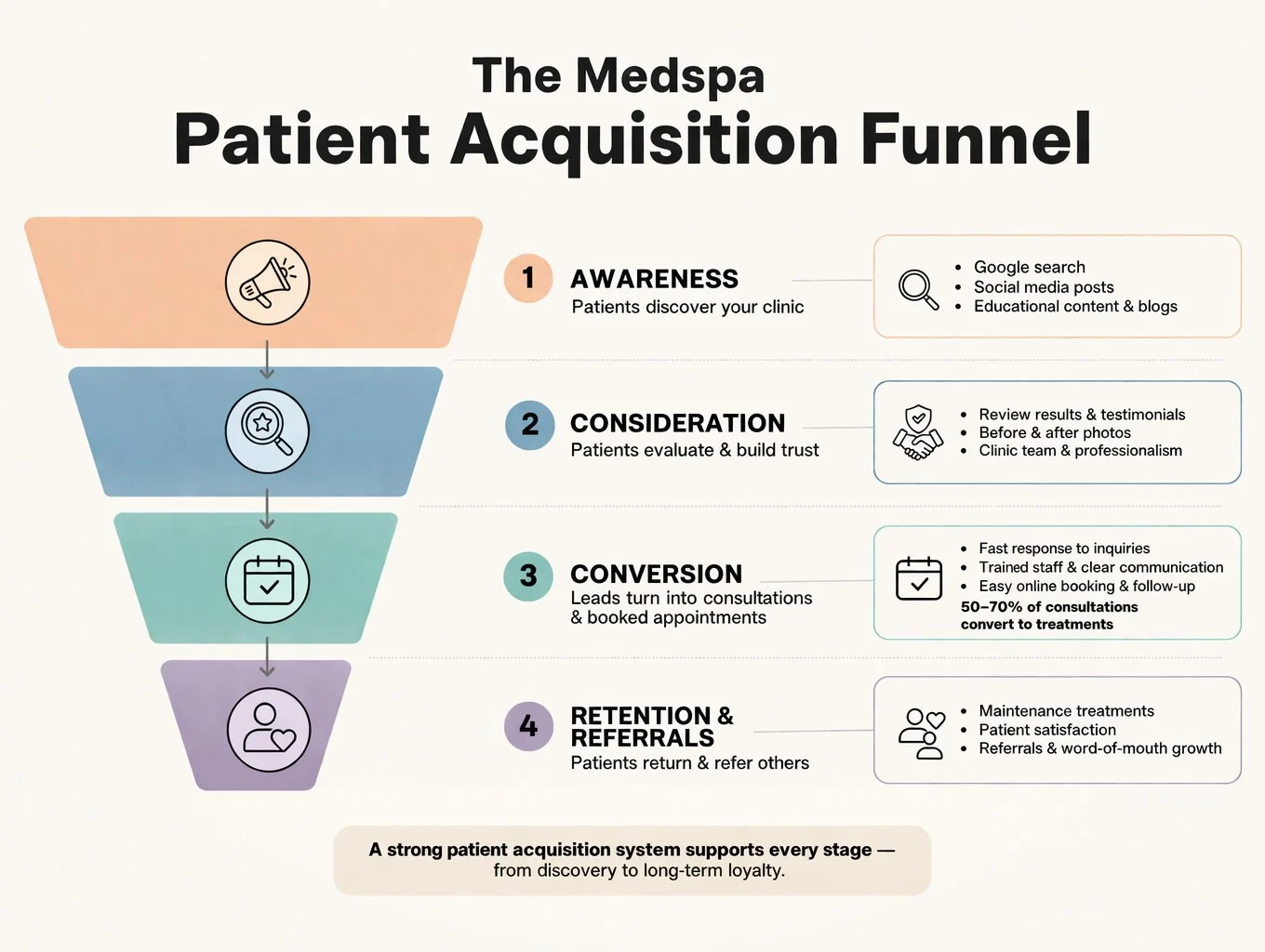
Understanding this funnel is essential because the most successful clinics don't rely on a single marketing tactic. Instead, they build a complete patient acquisition system that supports every stage of the journey—from discovery to long-term loyalty.
The 5 Pillars of a Successful Medspa Patient Acquisition System
Once you understand the patient journey, the next step is building the system that supports every stage of the funnel. Successful medspas don't rely on a single marketing tactic. Instead, they combine multiple channels and processes that work together to generate consultations consistently.
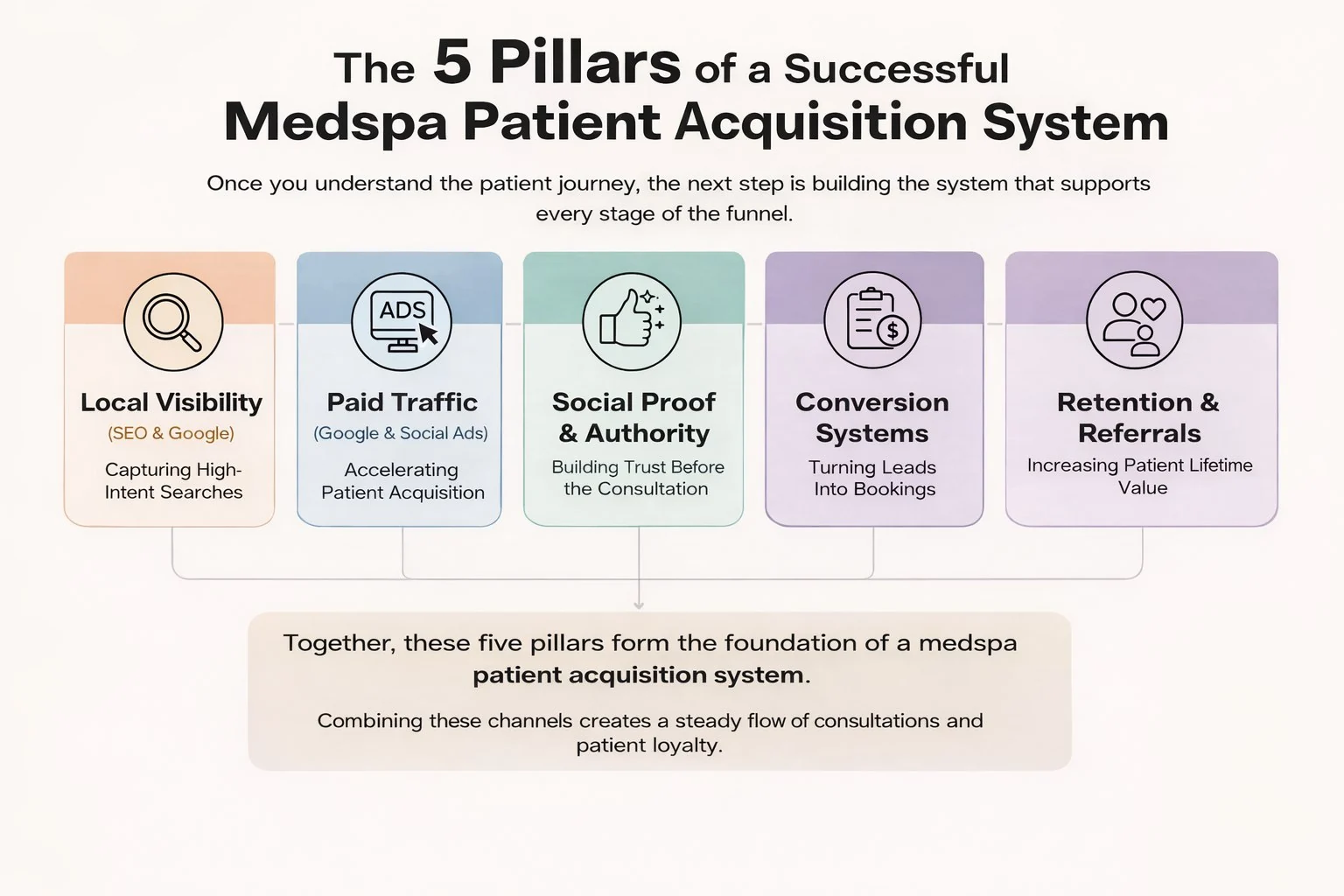
A complete medspa patient acquisition system typically relies on five core pillars.
Pillar 1: Local Visibility (SEO & Google) — Capturing High-Intent Searches
Most patients begin their search for aesthetic treatments on Google. They often look for specific procedures available near them, such as Botox, lip fillers, laser hair removal, or Morpheus8 treatments.
Typical patient searches include queries like:
- Botox near me
- lip fillers near me
- laser hair removal clinic near me
- Morpheus8 treatment results
If your clinic does not appear for these types of searches, potential patients will simply choose a competitor that is easier to find. Strong local SEO helps clinics improve their brand visibility and capture high-intent treatment searches.
Local visibility comes from several key elements:
- ranking for treatment-based searches
- optimizing your Google Business Profile
- building local landing pages for procedures
- collecting positive patient reviews
Clinics that invest in local SEO benefit from high-intent traffic—people actively looking for aesthetic treatments in their area. If you want to improve your visibility for treatment searches, read our guide on how to rank for local treatments with MedSpa SEO.
Pillar 2: Paid Traffic (Google Ads and Social Ads) — Accelerating Patient Acquisition
While SEO builds long-term visibility, paid advertising allows clinics to generate patients more quickly. Platforms like Google Ads and Meta Ads help clinics reach potential patients who are actively researching treatments or showing interest in aesthetic services.
Paid traffic strategies typically include:
- Google Ads targeting treatment keywords
- Meta Ads promoting consultations or offers
- retargeting campaigns for website visitors
When managed properly, paid advertising can create a steady flow of consultations while your organic marketing continues to grow. If you want to understand how clinics run effective ad campaigns, see our guide on Med Spa Google Ads: How to Drive New Patients Without Wasting Budget.
Pillar 3: Social Proof and Authority — Building Trust Before the Consultation
In aesthetic medicine, patients rarely choose the first clinic they find. They look for signs that the clinic is trustworthy, experienced, and capable of delivering results. This is where social proof and authority become essential.
Patients often evaluate clinics based on:
- before-and-after results
- patient testimonials
- educational social media content
- professional branding and presentation
Clinics that consistently showcase results and patient experiences build trust long before the consultation happens. For example, strong Instagram content and patient stories can significantly increase the likelihood that someone chooses your clinic. Learn how to leverage this effectively in our guide on ways to use patient testimonials in medspa marketing.
Pillar 4: Conversion Systems — Turning Leads Into Bookings
Generating leads is only part of the process. Many medspas lose potential patients because they lack strong lead management systems to convert inquiries into booked consultations. Even a well-performing marketing campaign can fail if the clinic does not respond quickly or handle inquiries effectively.
Strong conversion systems include:
- clear booking processes
- trained front desk staff
- effective phone scripts
- follow-up with leads who have not booked yet
Improving these processes often increases consultation bookings without increasing marketing spend.
Pillar 5: Retention and Referrals — Increasing Patient Lifetime Value
The final pillar of patient acquisition is often overlooked: retention and referrals. Satisfied patients frequently return for additional treatments and recommend the clinic to others. This creates a powerful growth loop that lowers acquisition costs over time.
Retention strategies include:
- email newsletters
- SMS reminders
- loyalty programs
- referral incentives
When clinics maintain strong relationships with existing patients, they generate a steady stream of repeat visits and word-of-mouth referrals. Together, these five pillars form the foundation of a medspa patient acquisition system. When they work together, clinics move away from unpredictable marketing and toward a more consistent flow of consultations.
Quick Win: Optimize Your Google Business Profile in 15 Minutes
If you only do one thing after reading this guide, do this. Your Google Business Profile is often the first thing patients see, and most clinics leave easy improvements on the table.
15-Minute GBP Checklist
- Update your primary category to "Medical Spa" (not "Day Spa" or "Beauty Salon"). This one change affects which searches you appear in.
- Add every treatment as a service with a description and price range. Google uses this information to match your profile with specific treatment searches.
- Add accurate, current photos of your clinic, team and treatment rooms. Use images you have permission to publish and review what visitors actually see on the profile.
- Write a Google Post this week. Share a before-and-after result, a seasonal promotion, or a patient testimonial. Posts show up directly in your search listing.
- Respond to every review you've received in the last 3 months, including the positive ones. A simple "Thank you, [name]! We're glad you loved your results" shows future patients that you care.
These five changes take 15 minutes and can improve your visibility in local search results within weeks. For a deeper dive, check out our complete guide on MedSpa Google Business Profile Optimization.
How Much Does It Cost to Acquire a Med Spa Patient?
The cost varies depending on the treatment, marketing channel, and how well the clinic's conversion systems are optimized. However, understanding typical benchmarks helps clinics evaluate whether their marketing is performing efficiently.
In general, medspa patient acquisition costs are influenced by three main factors:
- the marketing channel used to attract the lead
- the competitiveness of the treatment in your area
- how effectively your clinic converts inquiries into booked consultations
Inquiries, consultations and new patients are different outcomes. Calculate each progression rate from the clinic’s own records, and review reasons people did not progress before deciding which stage needs work.
If you want to separate lead price from booking quality, compare medspa cost per lead versus cost per booked consultation before judging whether a channel is actually profitable.
Typical Patient Acquisition Cost by Channel
Different marketing channels tend to produce different acquisition costs.
Local SEO. Organic traffic from Google often has the lowest long-term acquisition cost. Once a clinic ranks for treatment searches, new patients can arrive consistently without ongoing ad spend. However, SEO usually takes several months to produce strong results.
Google Ads: Search campaigns can reach people looking for offered treatments in your area. Costs and eligibility vary by treatment, market and campaign. Review current platform requirements and evaluate qualified inquiries and consultations rather than assuming a universal lead cost.
Social media ads: Creative can introduce the clinic and explain the consultation. Review the proposed treatment claims, imagery, audience setup and landing page against current platform requirements before launch. Compare qualified inquiries and booking outcomes, not just inexpensive leads.
Referrals. The lowest-cost acquisition channel. Referred patients arrive with built-in trust and convert at higher rates. The "cost" is maintaining the relationships and systems (loyalty programs, referral incentives) that keep referrals flowing.
Keep the denominator clear: Inquiry-to-booking rate uses all inquiries in the chosen group; attendance rate uses booked consultations. Neither is the same as the share who become patients.
Cost Differences by Treatment
Set an acquisition-cost limit using the clinic’s actual collected revenue, relevant delivery costs, capacity and retention evidence. A treatment’s headline price alone does not establish how much the clinic can profitably spend to acquire a patient.
Why Some Clinics Pay Much More Than Others
Two clinics in the same city can have dramatically different acquisition costs. Common reasons include:
- poor website or landing page experience
- slow response to inquiries
- weak consultation booking process
- lack of trust signals such as reviews or before-and-after photos
In many cases, clinics try to solve these issues by increasing ad spend, when the real problem lies in conversion and follow-up systems.
Reducing Patient Acquisition Costs
Clinics that lower acquisition costs usually improve several parts of their system simultaneously rather than relying on isolated marketing efforts. Some of the most effective improvements include:
- strengthening local SEO visibility
- improving consultation booking processes
- implementing better lead follow-up
- increasing retention and referrals from existing patients
When these elements work together, clinics can generate more consultations from the same marketing budget. Understanding acquisition cost is essential because it helps clinics evaluate whether their marketing system is sustainable.
If you want help implementing the complete funnel, see our medspa lead generation services for traffic, landing-page, follow-up, and consultation-tracking support.
Before choosing channels, set the goal in attended, paying patients (how to set a new patient goal) and decide whether you are scaling what works or building from zero. If you are building, the First Visit Method is one way to get the first attended patients.
How Medspa Market Pro Helps Clinics Build a Predictable Patient Acquisition System
Many medspas try multiple marketing tactics—social media posts, ads, or promotions—but struggle to connect them into a system that consistently generates consultations.
Medspa Market Pro helps clinics build a structured patient acquisition system that combines the key elements covered in this guide:
- local SEO to capture high-intent treatment searches
- paid campaigns that generate new inquiries quickly
- trust-building content such as before-and-after results and testimonials
- optimized consultation booking and lead follow-up
- retention strategies that increase patient lifetime value
Unlike most agencies, the focus is not on isolated marketing tactics but on building a complete patient acquisition system.
👉 Want to build a patient acquisition system for your clinic? Get in touch to discuss how we can help.