
If your MedSpa is getting leads but your schedule still has gaps, it's probably not your ads. It's your front desk.
When new leads wait too long, calls feel unstructured, and consults get booked with zero commitment, leads turn into no-shows or price shoppers. The moment a lead reaches out is the perfect time to begin building trust and authority, not hours later when interest has faded.
The fix isn't "better leads." It's front desk training built around speed, structure, and commitment, so calls turn into booked, ready-to-buy patients.
What Front Desk Training Really Means in a MedSpa
When MedSpa owners hear "front desk training," they usually think about phone etiquette or basic onboarding for their front desk staff. That's not what actually moves revenue.
In many clinics, receptionists are still trained as schedulers, even though their responsibilities directly affect bookings, show rates, and revenue.
In a MedSpa, the front desk is the first clinical touchpoint. Not an admin role. It's a revenue-facing job, not just desk work for support staff. It's where trust is built, authority is established, and the entire consult is framed.
If that moment is unstructured, everything that follows becomes harder, including closing, pricing conversations, and show rates.
Effective MedSpa Front Desk Training Focuses On:
- Responding to new inquiries fast enough to catch intent
- Guiding conversations instead of improvising them
- Creating commitment before the consult is booked
This is why two clinics can run the same ads, offer the same treatments, and get completely different results. One relies on "good people on the phone." The other relies on a repeatable system that works regardless of who answers.
Front desk training isn't about turning your team into salespeople. It's about giving them a clear framework so every call feels confident, professional, and intentional, not casual or reactive.
Why Most MedSpa Front Desks Fail to Convert Calls
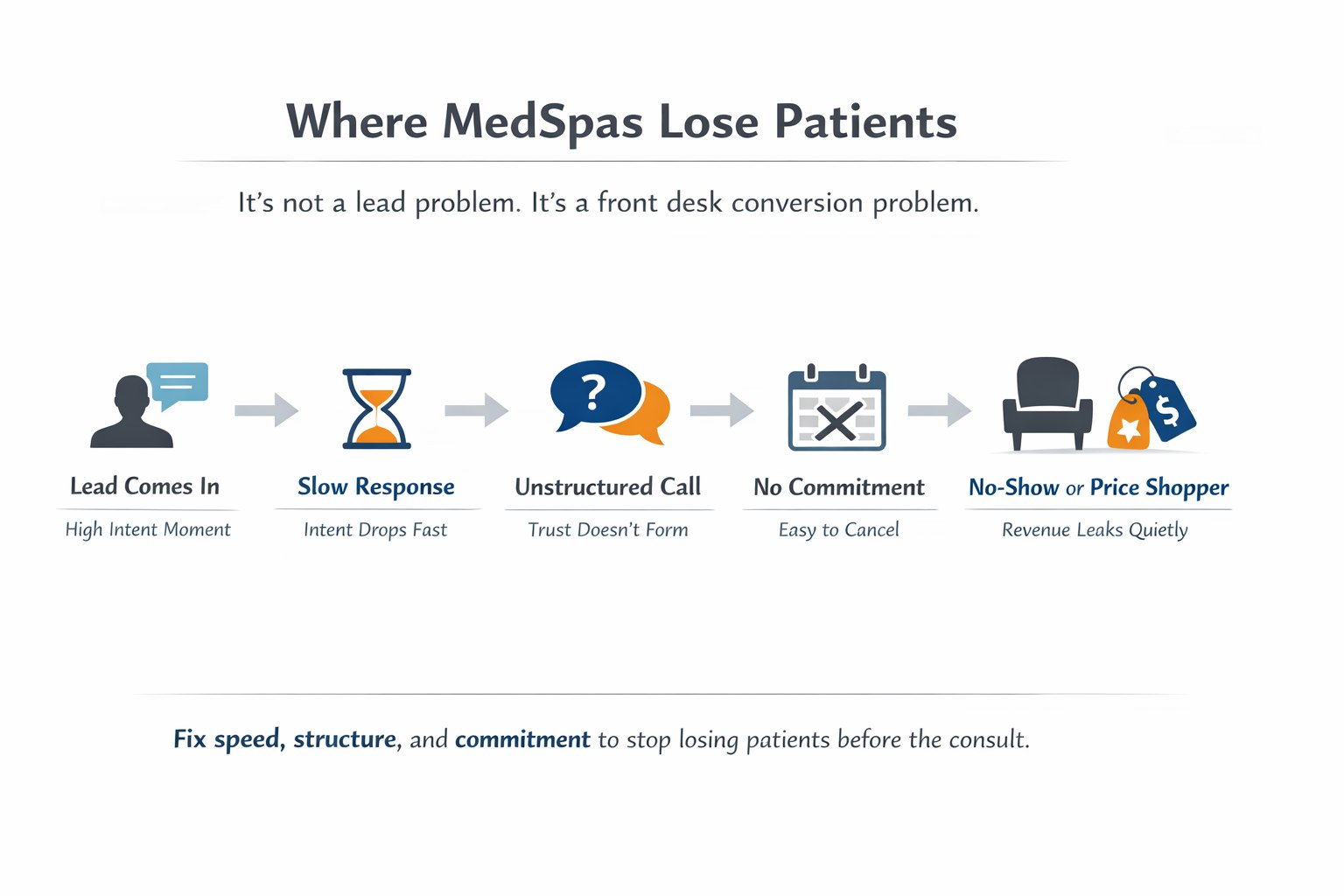
When leads don't turn into patients, it's easy to blame price, competition, or "low-quality" inquiries. In reality, most lost revenue happens before any of that matters, during the first interaction with your front desk.
Across clinics, the same three breakdowns show up again and again.
📊 Key Stat: Research from Harvard Business Review found that leads contacted within 5 minutes are 21 times more likely to convert than those contacted after 30 minutes. In a MedSpa, that window is even tighter because patients are often comparing 2 or 3 clinics at the same time.
First, response is too slow. Whether a patient decides to contact you by phone, text, or mail, the expectation is the same: someone will speak with them quickly and confidently. By the time someone fills out a form or calls, they're already comparing options. If your team responds late, even by an hour, you're no longer leading the conversation. You're reacting to someone who's already half gone.
Second, conversations lack structure and effective communication. Many front desk teams rely on intuition or personality. That works sometimes, but it creates inconsistency. Patients hear different explanations, different tones, and different next steps depending on who answers, which quietly damages trust in your service.
Third, there's no commitment before the consult. Appointments get booked easily, but nothing anchors the patient to show up or move forward. Without commitment, no-shows rise, price sensitivity increases, and close rates drop.
None of these issues are about effort or intent. They're about the absence of a system. High-performing MedSpas don't rely on "good calls." They rely on repeatable rules that protect speed, structure, and commitment every single time.
The 3 Front Desk Principles Used by High-Performing MedSpas
High-performing MedSpas and multi-location practices don't rely on charisma, years of experience, or "natural" closers at the front desk. They train around a few non-negotiable principles that shape every call and message, no matter who's on shift.
Principle 1
For more on this topic, see our guide on Med Spa phone script guide to book more leads.
Speed Sets Authority
When a lead reaches out, they're at peak intent. The clinic that responds first becomes the reference point. Fast response signals professionalism, organization, and trust. Slow response invites comparison shopping.
Principle 2
Structure Beats Improvisation
Free-flow conversations feel friendly, but they dilute authority. High-converting front desks guide the interaction with intention. Structure keeps the conversation focused on outcomes, not small talk or price too early.
Principle 3
Commitment Changes Behavior
Patients who feel no commitment treat consults casually. High-performing clinics build commitment into the booking process so consults are respected and show rates stay high.
These principles don't require aggressive sales tactics or pressure. They create clarity. When speed, structure, and commitment are present, the front desk stops "handling inquiries" and starts directing patient flow.
What a High-Converting MedSpa Front Desk Conversation Looks Like
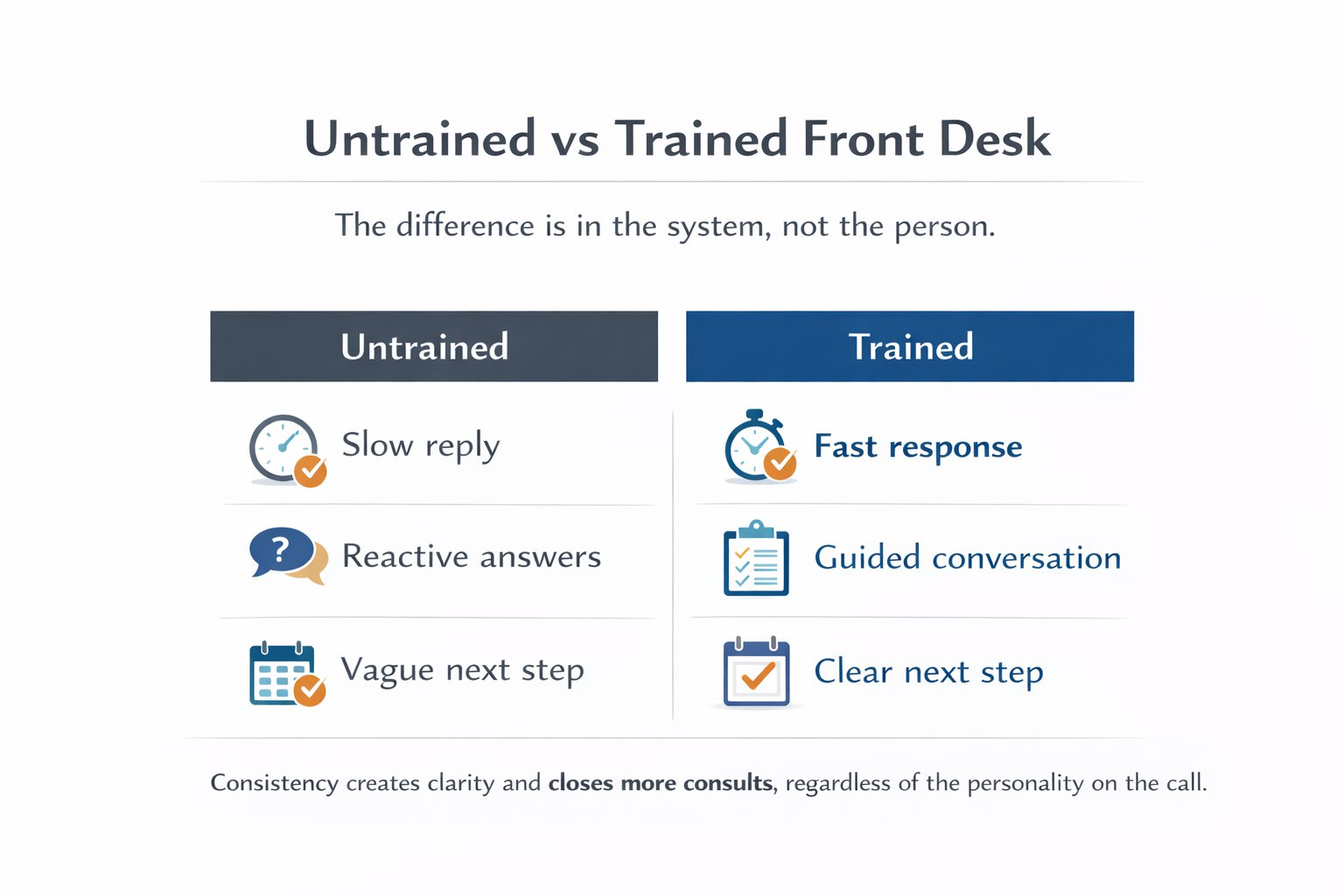
A high-converting front desk conversation doesn't sound pushy, scripted, or sales-driven. In fact, it usually feels calm, professional, and surprisingly simple. The difference is not in the tone, but in the flow.
The first few seconds of a call create the impression that shapes the entire consult, and simple things like tone and greetings play a bigger role than most clinics realize.
The High-Converting Call Flow
- Acknowledge quickly and confidently. This immediately reassures the patient that they're in the right place and that their request is being handled by a professional clinic, not a generic booking desk.
- Guide, don't react. Instead of answering every question as it comes or jumping straight to prices, ask a few intentional questions to understand why the patient reached out and what outcome they're looking for. This positions your team as advisors, not order-takers.
- Frame the consult as a diagnostic step. Patients should understand that the purpose of the consult is to assess, personalize, and recommend, not to pressure them into a treatment on the spot. This reduces resistance and builds trust before pricing is ever discussed.
- End with a clear next step. There's no vague "we'll see" or "call us back if you want." The patient knows exactly what happens next, when it happens, and what's expected of them.
Pro Tip: Treating callers like customers looking for prices creates resistance. Treating them like clients looking for guidance builds trust.
When this flow is consistent, calls feel controlled without feeling cold. Patients feel heard, guided, and confident, which is exactly what increases show rates and conversions, even before any advanced scripts or automation are added.
Why Front Desk Consistency Matters More Than Talent
Many MedSpa owners and medical providers believe their results depend on having the "right" person at the front desk. Someone who's naturally warm, confident on the phone, and good with people. The problem is that talent doesn't scale, and it doesn't protect your revenue when that person is out, overwhelmed, or replaced.
When conversations depend on personality, outcomes vary. One lead gets a great experience. The next gets rushed. Another hears a completely different explanation of the same consult. Over time, this inconsistency shows up as unpredictable bookings, uneven close rates, and growing frustration around "lead quality."
High-performing MedSpas remove this risk by standardizing how conversations are handled. Not to make them robotic, but to make them reliable. Every patient should experience the same level of clarity, confidence, and guidance, no matter who answers the phone or DM in your office.
Consistency turns front desk training into an operating system, not a one-time coaching session. It protects speed during busy hours, keeps conversations structured under pressure, and ensures commitment is built into every booking.
Once consistency is in place, individual skill becomes a bonus, not a bottleneck. And that's when growth becomes predictable instead of fragile.
How to Tell If Your Front Desk Is Costing You Revenue
Most front desk issues don't feel dramatic. Phones get answered. Messages eventually get replied to. The calendar looks reasonably full. On the surface, everything seems "fine."
But there are a few quiet signals that tell a different story.
If leads regularly wait more than a few minutes for a response, you're losing high-intent patients before the conversation even starts. If your team explains consults differently depending on who answers, trust erodes without you noticing. And if no-shows feel normal or unavoidable, that's almost always a commitment problem, not a scheduling one.
Red flags you'll hear over and over:
- "I need to think about it."
- "I'm just comparing options."
- "I'll call you back."
These aren't objections. They're symptoms of conversations that weren't guided properly. When conversations don't encourage commitment or engage the caller early, most patients leave undecided.
A well-trained front desk doesn't rely on hope or follow-up luck. It creates clarity early, sets expectations clearly, and makes the next step obvious and respected. When that's missing, revenue leaks quietly, even when lead flow looks healthy.
Front Desk Training Is a System, Not a Collection of Scripts
This is where many MedSpas get stuck. This isn't about buying new software or tracking every number. It's about fixing the conversation before the consult.
They look for a better phone script, a smarter reply, or a new follow-up message, hoping that one change will fix conversions. It rarely does.
Scripts only work when they sit inside a system. Without clear rules around response speed, conversation flow, and commitment, even the best wording falls flat. Your team may say the "right" thing, but at the wrong time, or without the authority that structure creates.
Pro Tip: High-performing MedSpas train their front desk the same way they run clinical protocols. There's a defined flow, a clear objective for each step, and a standard everyone follows. That's what makes results repeatable, even during busy days or staff changes.
This approach also keeps your brand consistent. Patients don't experience mixed messages or uncertainty. Every interaction reinforces the same positioning: professional, organized, and in control.
The difference isn't more training hours or more personality. It's having a front desk system that works quietly in the background, guiding every call and message toward the same outcome.
When patients feel guided and committed, the decision to purchase feels natural, not pressured, and cash flow becomes more predictable.
Want the Full Front Desk Playbook?
This guide is meant to give you the framework, not overwhelm you with scripts, tools, or tactics taken out of context. Once you understand how speed, structure, and commitment work together, execution becomes much simpler.
If you want the exact wording, step-by-step processes, and automations high-performing MedSpas use to turn inquiries into booked, committed patients, that's what The Closing Playbook is for.
The Closing Playbook breaks these strategies down so your team can learn what actually drives consult success, not just what sounds good in theory. It's the operational layer behind everything you've read here, built to be implemented quickly by your front desk team.
No theory. No fluff. Just a clear system you can plug in and run. Many clinics see measurable improvements within the first week of tightening their front desk process.
If your clinic is getting leads but conversions feel inconsistent, tightening your front desk is one of the fastest ways to improve your service delivery and protect your business without increasing ad spend.
FAQs
Front desk training in a MedSpa goes beyond phone etiquette. It's a structured system that teaches your team to respond fast, guide conversations with intention, and build patient commitment before the consultation is booked. It directly impacts bookings, show rates, and revenue.
The three most common reasons are slow response times, unstructured conversations that vary by who answers, and no commitment built into the booking process. These issues cause patients to comparison shop, no-show, or say "I'll think about it."
Within 5 minutes or less. Research from Harvard Business Review shows that leads contacted within 5 minutes are 21 times more likely to convert than those contacted after 30 minutes. In aesthetic medicine, patients are often comparing multiple clinics simultaneously.
Scripts alone don't fix conversions. They only work when placed inside a system with clear rules around response speed, conversation flow, and commitment. A structured framework that your team follows consistently is more effective than memorized lines.
Common signs include high no-show rates, leads frequently saying "I need to think about it," inconsistent explanations of services depending on who answers, and slow response times to inquiries. If your lead flow looks healthy but bookings feel unpredictable, your front desk process is likely the bottleneck.